
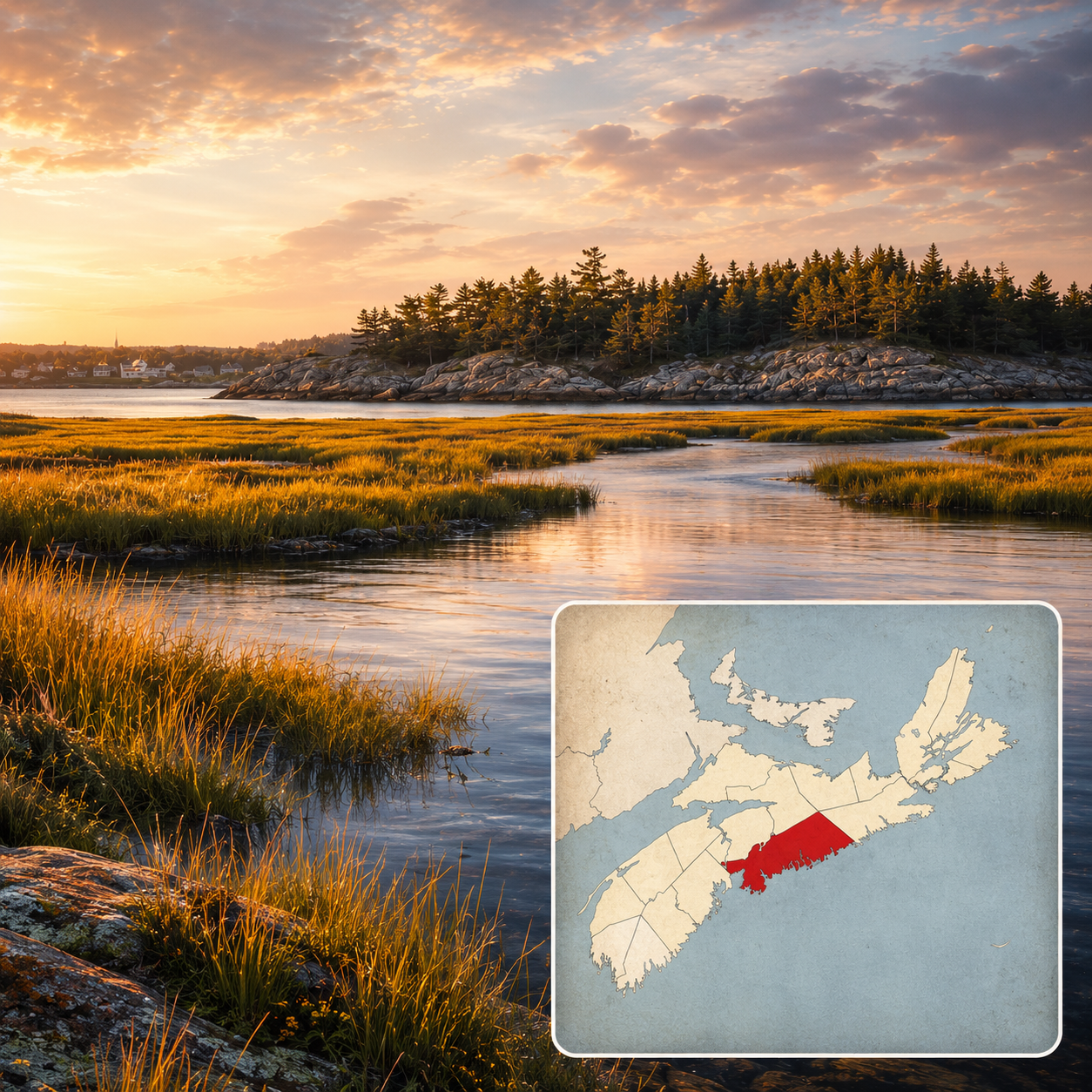
Developing baseline data, soil carbon information, site profiles, maps, and decision-support tools for three representative coastal wetland sites in Halifax Regional Municipality (HRM).
A focused phase of the HRM Blue Carbon Pilot and Climate-Ready Pathway.
Blue Maritimes Society is carrying out a coastal wetland baseline pilot with funding from the Halifax Climate Investment, Innovation and Impact Fund (HCi3). The project will build practical baseline evidence to support coastal wetland protection, restoration planning, monitoring, and climate resilience in Halifax/Kjipuktuk.
This phase focuses on three representative coastal wetland sites within HRM. The work will generate site-level information on soil carbon, wetland conditions, hydrological context, restoration relevance, and future monitoring needs. The project is designed to support better decisions before larger restoration, mitigation, compensation, or long-term stewardship actions move forward.
What this HCi3-supported phase will do
The project will combine field sampling, site documentation, GIS mapping, laboratory analysis, and technical interpretation to produce a clearer picture of selected coastal wetlands in HRM.
Core activities include:
Field-based baseline data
Collect site-level information through soil or sediment sampling, field notes, GPS records, photographs, site descriptors, and vegetation observations.Soil carbon and ecosystem assessment
Analyze soil or sediment carbon and related site conditions to better understand carbon storage, vulnerability, and restoration relevance.GIS mapping and site profiles
Produce maps and site profiles that help partners understand location, site context, risks, opportunities, and future monitoring needs.Decision-support tools
Develop practical outputs that can support municipal, partner, and community conversations about wetland conservation, restoration, and climate resilience.Knowledge sharing
Prepare technical and plain-language materials that explain the climate importance of coastal wetlands and the value of protecting them before degradation occurs.
Expected outputs
By the end of this phase, Blue Maritimes will produce:
An HRM-specific blue carbon baseline dataset for three selected coastal wetland sites.
A decision-support map set.
Site profiles and interpretation materials.
A prioritization framework for future conservation and restoration pathways.
A concise policy brief for municipal and partner use.
A methodological document to support replication in other coastal wetlands.
Accessible public-facing materials explaining the role of coastal wetlands in climate resilience and long-term public value.
What this project is not
This phase is not a carbon credit project. It does not make carbon market claims, valuation claims, or offset claims. It is a baseline-first project focused on credible science, transparent uncertainty, and practical public benefit.
Why this matters
Coastal wetlands can store carbon, reduce flood and storm impacts, support biodiversity, improve water quality, and strengthen shoreline resilience. However, many sites lack the local baseline data needed to guide future protection, restoration, or monitoring.
This HCi3-supported phase helps fill that gap by producing the evidence, methods, and decision-support tools needed to move from general recognition of coastal wetlands to practical climate action in HRM.
Want to learn more?
Blue Maritimes welcomes conversations with funders, conservation partners, municipalities, researchers, and public-interest organizations interested in supporting or collaborating on coastal wetland baseline work in Nova Scotia.